War Overview · First Sino-Japanese War (1894–95)
Japan, after more than twenty years of military expansion following the Meiji Restoration, fought a war over Korea against the recently established Beiyang Navy and the sprawling Qing army; in nine months the Qing forces did not win a single major battle, and the Treaty of Shimonoseki that followed broke apart the old order of East Asia.
Engagement Data
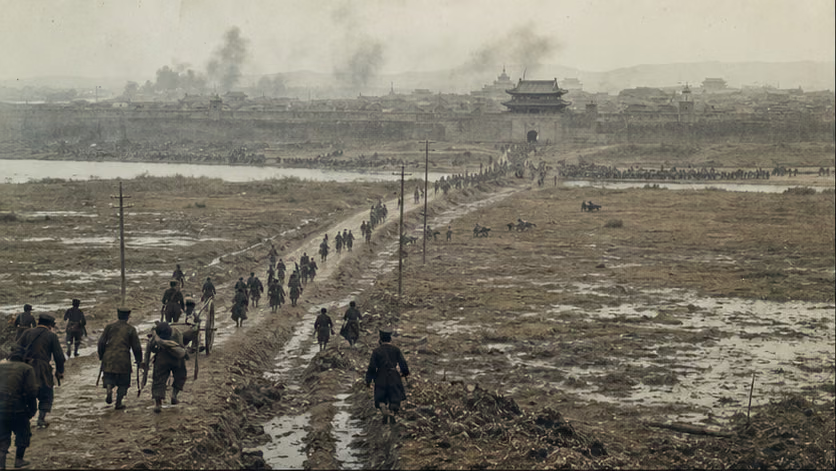
| Item | Details |
|---|---|
| Time | 1894.7.25 (Battle of Pungdo, war begun without declaration) – 1895.4.17 (Treaty of Shimonoseki signed); if the Resistance Against the Japanese Takeover of Taiwan (1895) is included, it extends to 1895.10 (Resistance Against the Japanese Takeover of Taiwan [1895] belongs to the second half of the batch; cross-referenced here) |
| Place | Korean Peninsula -> Yellow Sea -> Liaodong Peninsula -> Weihaiwei, Shandong |
| Belligerents | Great Qing (Guangxu reign) / Japan (Meiji 27–28) |
| Result | 1895.4.17 Treaty of Shimonoseki: cession of the Liaodong Peninsula (later redeemed after the Triple Intervention), Taiwan, and Penghu; indemnity of 200 million taels for military expenses; four additional treaty ports opened; permission for factories to be established at treaty ports |
Three "opening dates" coexist: 1894.7.23, when Japanese forces raided Gyeongbokgung in Hanseong and seized the Korean king (the opening date from a Korean perspective); 7.25, the interception at sea off Pungdo (the war in fact); and 8.1, when China and Japan declared war on the same day (the war on paper). The dislocation among the three was itself the beginning of the war.
Belligerents (War Level)
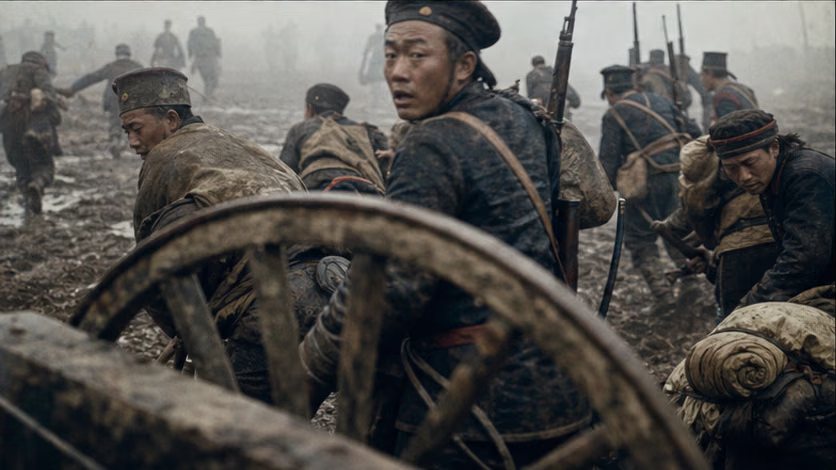
| Item | Qing forces | Japanese forces |
|---|---|---|
| Total strength | The Eight Banners and Green Standard carried nominal numbers in the hundreds of thousands; those able to fight were the Zhili Huai-trained armies, numbering in the tens of thousands; wartime mobilization from the provinces cumulatively reached several hundred thousand (measurement standards differ sharply, with divergent accounts) | Seven standing army divisions; wartime mobilization of about 240,000 (Japanese figures), organized into the First Army and Second Army and committed in sequence |
| Navy | The four fleets of Beiyang, Nanyang, Fujian, and Guangdong were not under unified command; in actual combat only Beiyang engaged the enemy. After the Beiyang Navy was formed in 1888, no additional ships were added (the exact scope of "no ships or guns added" remains unverified) | The Combined Fleet operated under unified command and added ships year by year in the same period; Yoshino entered service in 1893 and was then described as the fastest cruiser in the world |
| Firepower | Much of the fleet's artillery was mounted on recoil-slide carriages, with slow rates of fire, and shell reserves were insufficient (see Battle of the Yalu River [1894] for details) | Quick-firing guns held an overwhelming advantage, with ample high-explosive shells (data on the Japanese rate-of-fire advantage remains unverified) |
| Army equipment | Small arms and artillery were not inferior overall; in some units, Mauser repeating rifles and Krupp guns were superior to those of the Japanese army | Murata single-shot rifles and bronze field guns; infantry firearms did not in fact hold an advantage |
| System | The imperial and empress-dowager factions contended; the Guangxu Emperor favored war, while Li Hongzhang relied on Beiyang, avoided battle to preserve the ships, and looked to British and Russian mediation; reports from the front were falsified layer by layer (see separate chapters for the chain of false reporting) | The Imperial General Headquarters and command system were unified; Japan's first wartime national mobilization was set in motion, with newspapers, military post, and conscription all fully activated |
Korea's position (the third perspective): the first half of the battlefield lay on Korean soil, and the war began out of internal disorder in Korea. In spring 1894, the Donghak Peasant Uprising broke out, and the Korean king asked Qing forces to help suppress it. Japan sent troops at the same time under the 1885 Sino-Japanese Convention of Tientsin; after the disorder was nearly pacified, Japan refused to withdraw and instead reinforced Hanseong. On 7.23, Japanese troops forced their way into Gyeongbokgung, seized King Gojong, installed a puppet government headed by the Daewongun (details unverified), and compelled it to "entrust" Japanese forces with expelling the Qing army. The first shot of the war thus fell first on the Korean court. The situation of the Korean people, caught between the two countries' armies and requisitions, is sparsely recorded in both Chinese and Japanese sources (available source coverage is limited; Korean-side archives remain to be checked).
Historical Setting
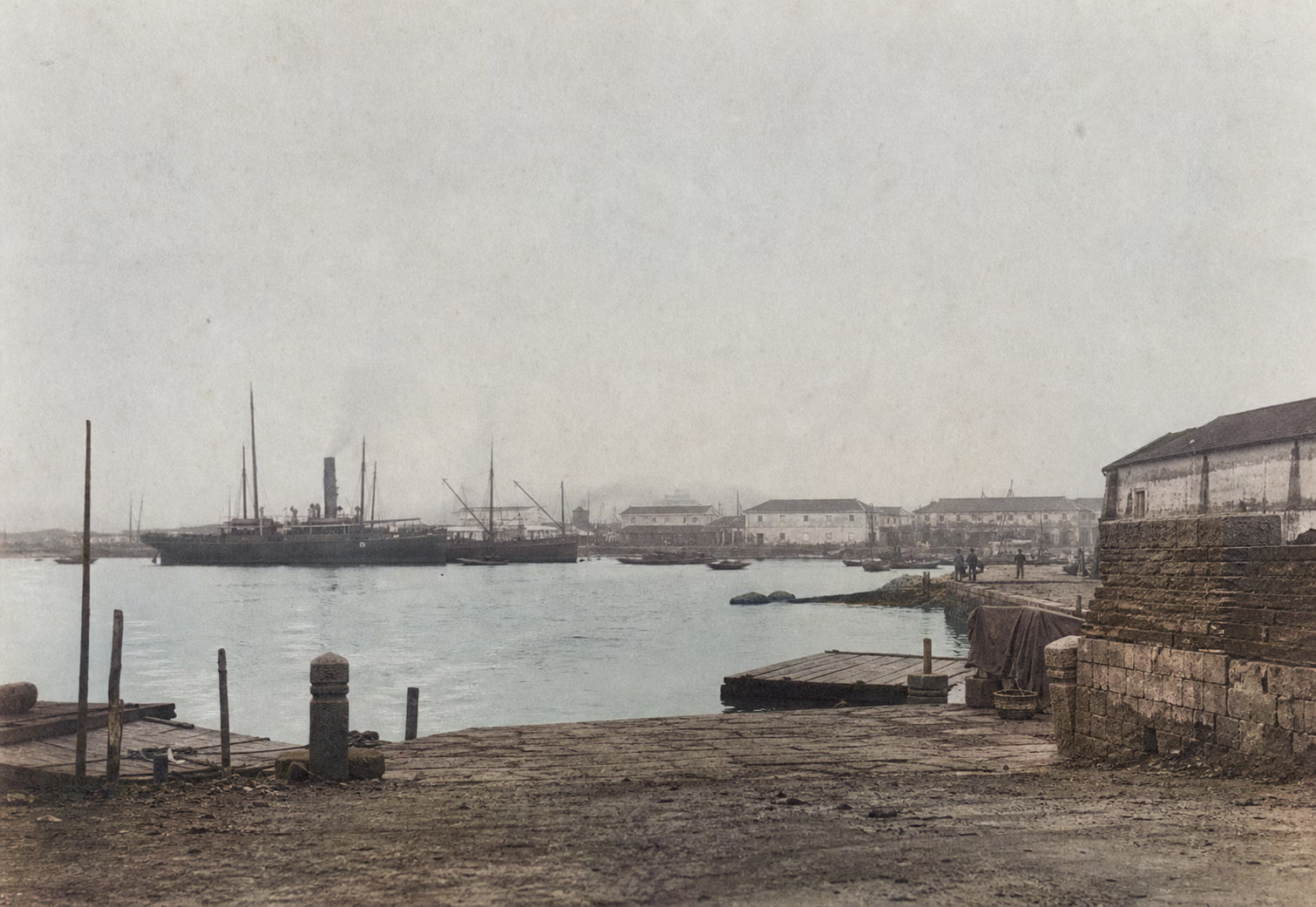
World: the Second Industrial Revolution was at the threshold, and rivalry among the powers was shifting toward capital export and the seizure of colonies. Korea was Northeast Asia's last "undetermined land": Russia began work on the Siberian Railway in 1891, pointing beyond Vladivostok; Britain and Russia confronted each other in the Far East; and Britain, in order to contain Russia, was willing to support Japan. The board of the great powers had been set; only the pieces had yet to move.
China: thirty years of the Self-Strengthening Movement had produced steamships, guns, and a new-style navy, a respectable balance sheet on paper. Beneath it lay fiscal distress and a patched-together military system: the navy, trained armies, and yongying forces each formed their own systems, with no unified staff institution. In 1894, the sixtieth birthday celebrations for Empress Dowager Cixi overwhelmed war preparations; under the struggle between the imperial and empress-dowager factions, the debate over war and peace kept wavering between "fight" and "rely on foreign mediation."
Japan: twenty-six years after the Meiji Restoration, industrial promotion and the policy of "rich country, strong army" had achieved results. The "Continental Policy" used Korea as a stepping-stone, and more than twenty years of military expansion and war preparation had taken the Beiyang Navy as its imagined enemy. The domestic confrontation between the popular-rights parties and the hanbatsu cabinet was acute, and the government needed an external war to divert contradictions (this account of motive remains unverified). After the Diet approved military expenditures, the emperor issued an imperial rescript for military expansion, and the national mobilization system was driven at full power for a foreign war for the first time.
Why It Was Fought
Japan's resolve for this war had been accumulated over twenty years; the Qing court's had been dragged into being over four months.
Tokyo's decision chain was clear. In early June, Qing troops crossed the sea at Korea's request, and Japan sent troops at the same time under the Convention of Tientsin. By the time the first Japanese units arrived in Korea, the Donghak disturbance had nearly subsided; the pretext for withdrawal was gone. The cabinet and the Foreign Ministry then proposed that China and Japan "jointly reform Korea's internal administration." They knew the Qing court could not accept this; what they wanted was precisely its refusal (the details of this proposal being personally settled by Mutsu Munemitsu remain unverified). In late June, an imperial conference set the policy: reinforce Korea, undertake "reform" unilaterally, and risk a break with the Qing. On July 23, Japanese troops entered Gyeongbokgung and seized the king; on the same day, the Combined Fleet left Sasebo. The two orders fell on the same timetable. When Japan acted, it already held years of reconnaissance on the condition of the Beiyang fleet, Korean terrain, and Qing troop movements. What it lacked was certainty that the great powers, especially Britain, would not turn against it. After weighing the risk, Japan decided to take it. The wartime Imperial General Headquarters' operational policy was divided into three plans according to command of the sea: if command of the sea was gained, strike directly at the Zhili plain; if undecided, first secure Korea; if lost, fall back to defend the home islands (the texts of the three plans remain unverified). Before the war began, the entire course of the war had already been staked on naval battle.
On Beijing's side, resolve was never truly formed. Li Hongzhang's line ran from June through July: commit only limited land forces, keep the fleet guarding the approaches, reinforce Asan to build momentum, and place hope in British and Russian mediation. He believed the powers would not sit by while Japan monopolized Korea; leasing the British steamer Kowshing to transport troops meant treating the British flag as a talisman. The imperial faction saw matters differently: Weng Tonghe and a group of censorial officials urged war day after day, and Guangxu issued repeated stern edicts blaming Li Hongzhang for delay. What the advocates of war had in hand was the old ledger of the "Celestial Court" managing Japan and the paper strength of Beiyang after its formation; what they did not have was the solid reality of Japan's twenty years of preparation, nor the price beneath Britain and Russia's verbal promises that would not be backed by action. In mid-July, Qing troops at Asan were still waiting for news of mediation while the other side's troops had already crossed the sea and landed. By August 1, when the two countries declared war on the same day, the Qing court had been dragged into the war amid the report of defeat at Asan and the gunfire that sank the Kowshing.
The material boundaries drawn for the two sides were already unequal before the war began. Japan's military expenditures had been passed by the Imperial Diet, public bonds could be issued at once, seven divisions under the conscription system stood at full strength, and railway and maritime transport were scheduled as one system. The Qing court's accounts were fragmented: the Board of Revenue treasury was empty, war expenses were pieced together from naval-defense contributions, interest-bearing merchant loans, and scattered foreign loans (fundraising details remain unverified). After 1891, Beiyang added not a single ship; provincial armies drew their own pay and followed their own commands; and for units rushing from inside the passes over a thousand li to reinforce the front, no unified line managed the transport of food and equipment. The two countries were not fighting the same kind of war: one had calculated the war before fighting it; the other fought while assembling what it could.
There was dissent on both sides, but with different outcomes. Tokyo's cabinet and parliament had previously been in fierce dispute, yet once war began the country moved in unison; no weighty opposition to the decision for war itself is recorded. Beijing's voices for peace never ceased from beginning to end. Beyond Li Hongzhang, the Grand Council and provincial officials repeatedly submitted arguments for preserving peace through retreat and ending matters through mediation. Only after defeat had already taken shape did peace become state policy rather than dissent. Korea, meanwhile, had no right even to dissent within this decision: in June the armies of two countries entered its territory; in July its palace was occupied by one of them; and its king, under the mouth of a gun, "entrusted" Japanese forces with expelling the other country's army. Its name was absent from the name of the war; the battlefield was Korea.
Course of the Engagement (Four Phases)
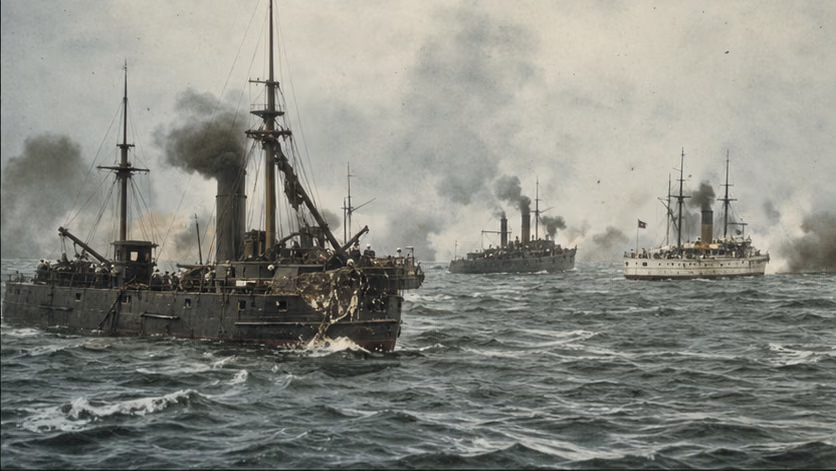
| Phase | Time | Key Points | Separate Chapters |
|---|---|---|---|
| Korean phase | 1894.7–9 | 7.23 occupation of Gyeongbokgung; 7.25 Battle of Pungdo and the sinking of the Kowshing; 7.28–29 Battle of Seonghwan; 9.15 Battle of Pyongyang, after which Qing forces abandoned Pyongyang within one day and night and fled for six days across the Yalu River, abandoning all of Korea | Outbreak of War: Pungdo and Seonghwan / Battle of Pyongyang (1894) |
| Command of the Yellow Sea | 1894.9.17 | Five-hour Battle of the Yalu River off Dadonggou: Beiyang lost five ships; Japan lost none, though many ships were badly damaged. Afterward the remaining Beiyang ships entered Weihai and never put to sea again, yielding command of the sea | Battle of the Yalu River (1894) |
| Liaodong phase | 1894.10–11 | 10.24–26 the Yalu River defense line was pierced in a single day and night, and the fighting entered Qing territory; the Second Army landed at Huayuankou; Jinzhou, Dalian, and Port Arthur fell in succession (※ Port Arthur Massacre, cross-referenced to the second half of the batch, Battles of Jinzhou and Port Arthur) | Defense of the Yalu River Line / (second half of the batch) Battles of Jinzhou and Port Arthur |
| Shandong phase and peace talks | 1894.12–1895.4 | Japanese forces landed at Rongcheng Bay, attacked Weihaiwei by land and sea, and destroyed the Beiyang Fleet (1895.2); the Liaodong front suffered successive defeats at Tianzhuangtai and elsewhere; the Shimonoseki peace was negotiated and signed | (second half of the batch) Battle of Weihaiwei / Resistance Against the Japanese Takeover of Taiwan (1895) |
Beneath Shimonoseki and the Treaty (1895.3–4)
In March 1895, Li Hongzhang traveled to Japan as minister plenipotentiary of the first rank and negotiated with Ito Hirobumi and Mutsu Munemitsu at Shunpanro in Shimonoseki. On 3.24, during a break in the negotiations, the Japanese right-winger Koyama Toyotaro shot Li Hongzhang; the bullet struck his cheek, but he survived. The Japanese side feared that the powers would use the opportunity to intervene and that the negotiations would collapse, so the emperor issued an edict condemning the attacker, and on 3.30 Japan promised an unconditional armistice (previously Japan had insisted on negotiating peace before any armistice, and the armistice scope did not include Taiwan or Penghu; details remain unverified). Li Hongzhang continued the negotiations while wounded, with almost no room to bargain.
The Treaty of Shimonoseki was signed on 1895.4.17. Its main terms were:
- China recognized Korea's "independence" (Article 1), which in reality meant Korea's departure from the Qing tributary order and its entry into Japan's sphere of influence;
- cession of the Liaodong Peninsula, the whole island of Taiwan and its affiliated islands, and the Penghu Islands;
- indemnity of 200 million Kuping taels for military expenses;
- opening of four additional treaty ports: Shashi, Chongqing, Suzhou, and Hangzhou;
- permission for Japanese subjects to establish factories and manufacture at treaty ports, with the goods produced taxed as imported goods. From this point, capital export by the powers into China gained its opening; later, other countries shared the benefit equally under the "most-favored nation" clause.
On 4.23, the Russian, German, and French ministers in Japan jointly "advised" Japan to give up the Liaodong Peninsula; this was the Triple Intervention. Japan could not match the navies of the three powers, and in November it signed an agreement returning Liaodong, while China paid an additional "Liaodong redemption fee" of 30 million taels. The Qing court paid 30 million taels to buy back its own territory, while the calculations each of the three powers had in mind, Russia's for Port Arthur and Dalian and Germany's for Jiaozhou Bay, came to collect one by one two years later.
Casualties and Losses
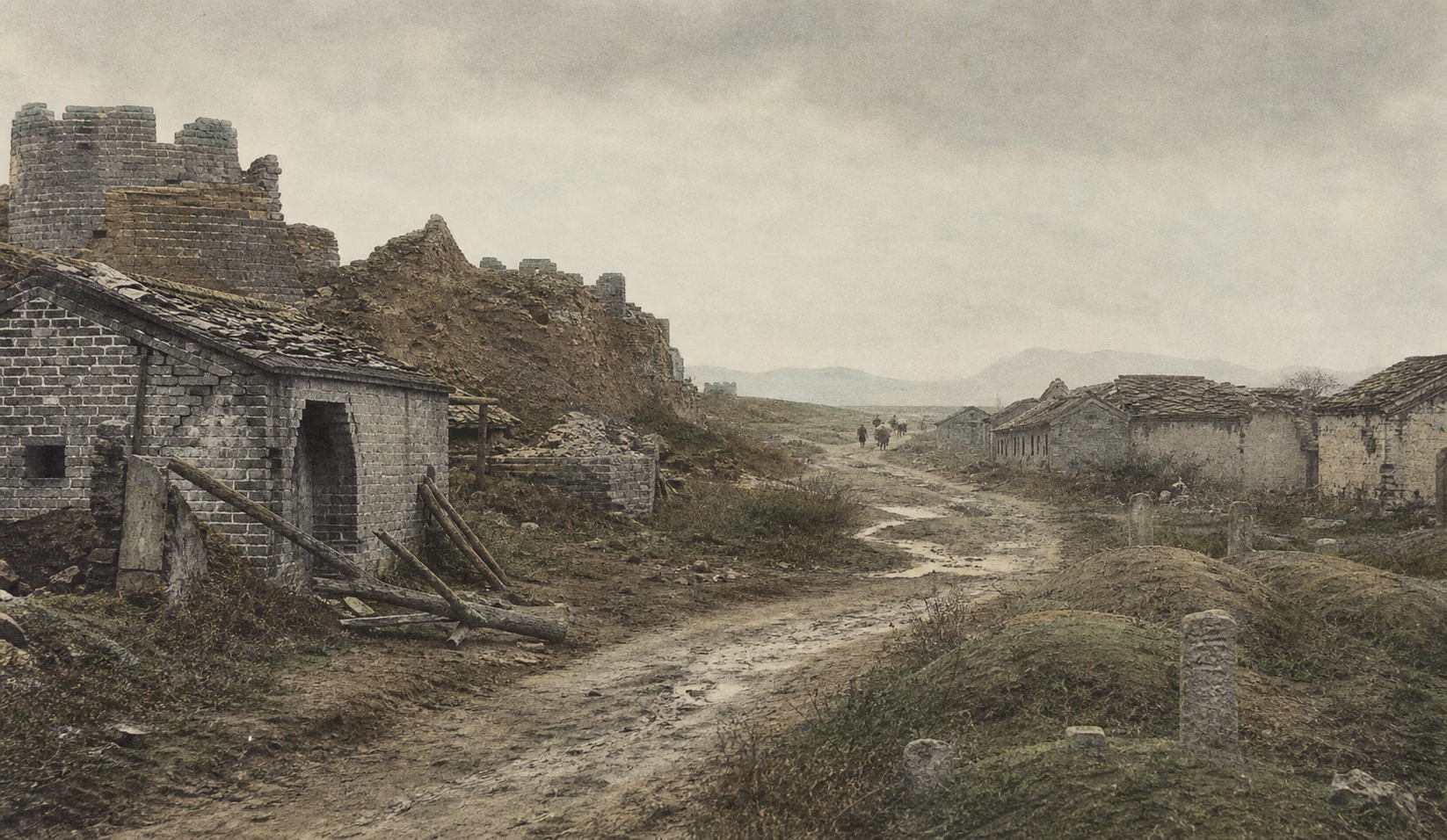
- Qing forces: total combat deaths across the engagements numbered in the tens of thousands, with no authoritative overall figure (one account gives roughly around 30,000 killed, but later research uses different measurement standards; figure disputed); the Beiyang Navy was completely destroyed, and the Huai-trained elite was swept away.
- Japanese forces: about 1,132 killed in action and about 11,894 dead of disease (Japanese statistical basis, widely re-cited online; whether the statistical boundary includes the 1895 Taiwan campaign remains unverified). Deaths from disease were ten times combat deaths. Cholera and beriberi (vitamin B1 deficiency) were the Japanese army's greatest enemies; this line belongs before the casualty table of any battle in the war.
- Civilians: no statistics exist for requisitions and war damage within Korea; on the Liaodong battlefield, ※ the death toll in the Port Arthur Massacre is highly disputed (see the second half of the batch; see also this overview).
- Finance: the 200 million taels of indemnity plus 30 million taels for redeeming Liaodong amounted to several years of Qing revenue (multiples vary by measurement standard and account); the Qing court was forced into large foreign loans (Russian-French loans and British-German loans), and customs and finance were further mortgaged to foreigners.
- Japanese side: the bulk of the indemnity was invested in military expansion and the Yawata Steel Works, and it also supported the 1897 gold standard. With China's indemnity, Japan prepared the next war (details of indemnity use remain unverified).
Aftermath
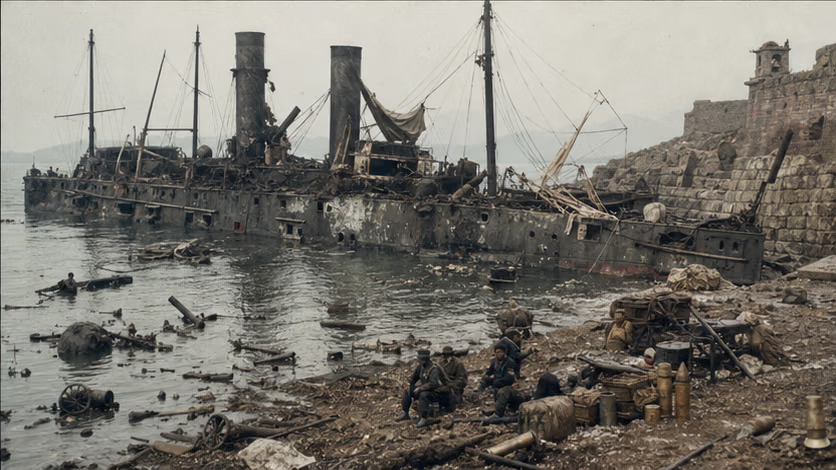
- Korea: Article 1, "Korean independence," severed the Qing-Korean tributary relationship, the final collapse of the two-thousand-year tributary order. In 1897, Gojong changed the country's title to the Korean Empire; in 1910 it perished under Japan. The line from "independence" to national extinction in fifteen years is the heaviest tail of the First Sino-Japanese War.
- Scramble for concessions: the Triple Intervention exposed the Qing court's bottom line. In 1897–98, Germany leased Jiaozhou Bay, Russia leased Port Arthur and Dalian, Britain leased Weihaiwei and the New Territories, and France leased Guangzhouwan; spheres of influence were drawn. The defeat of 1894–95 directly opened this door.
- The Gongche Shangshu and reform: when news of the treaty reached Beijing, examination candidates in May 1895 jointly submitted a petition (the "Gongche Shangshu"), and calls to reject peace, move the capital, and reform surged. The reform movement was directly provoked by this war, and three years later came the Hundred Days' Reform.
- Japan: Japan entered the waiting room of the great-power club and collided head-on with Russia in Korea and Manchuria. Ten years later came the Russo-Japanese War; its foreshadowing was laid here.
- Qing court: after Beiyang's destruction, the court organized and trained the New Army (the Xiaozhan training). The seed of the next chapter of Chinese military history was also planted in the ruins of this defeat.
How Each Side Records It
- Chinese side: within the sequence of modern national humiliations, this was one of the deepest thorns. Losing to a "tiny country" caused far greater shock than losing to Britain and France, and the "humiliation of Jiawu" directly gave rise to the two roads of self-rescue: reform and revolution. The Beiyang Navy, Deng Shichang, and the Port Arthur Massacre form the three cornerstones of memory.
- Japanese side: called the "Nisshin War," it was Meiji Japan's first foreign war of full national mobilization. Conscription, national debt, newspapers, military songs, and battlefield reporting were all activated in full for the first time. The victory narrative carried the legitimacy of "civilization against barbarism" into textbooks, and national consciousness was tempered into form through this war. Afterward it became the starting memory of the "Continental Policy," a layer of narrative that continued through Japanese modern historical writing until 1945.
- Korean side: Korea was a belligerent country and the battlefield country, yet in the treaty it was disposed of under the name of "independence." Korean historiography calls it the "Qing-Japanese War" and emphasizes that Korea was the third party on whose own soil two empires opened war (details of Korean scholarly phrasing remain unverified).
Disputes and Sensitivities
- "Naval funds were used to repair the Summer Palace": a popular narrative says that Cixi diverted naval funds to repair the palace, leaving Beiyang without ships or guns. Historical textual research shows a more complex reality: the Naval Yamen's funds were indeed advanced or diverted, and "naval-defense contributions" were indeed moved to projects at the Three Lakes and the Summer Palace, but the amounts and nature of the matter, whether diversion or interest-bearing turnover, have been repeatedly reexamined. Beiyang's halt in ship and gun purchases also involved the Board of Revenue's dispute over north-south Beijing funds and Li Hongzhang's own calculations. The popular narrative and the textual research are placed side by side here; neither is adopted alone.
- Li Hongzhang: the century-old verdict that the signer of the treaty was a "traitor" coexists with a sympathetic reevaluation that "the defeated have no diplomacy." Whether his prewar line of avoiding battle to preserve the ships and relying on mediation was a strategic misjudgment or the only realistic option remains disputed.
- The Fang Boqian case and the Wei Rugui case (two military-law executions for fleeing in the face of battle, each with arguments that injustice was done): for details and both sides, see the dispute sections of Battle of the Yalu River (1894) and Battle of Pyongyang (1894).
- The "sand-mixed shells" claim: a popular narrative says Beiyang shells were embezzled and mixed with sand; research on ordnance shows that solid shot contained no explosive in the first place, and that the sand-mixing claim was connected to shell types. Both accounts are placed side by side; for details, see Battle of the Yalu River (1894).
- Gongche Shangshu: in the traditional narrative, this event is the starting point of reform; modern scholars have disputed, on textual grounds, the reliability of Kang Youwei's account (accounts differ). This chapter writes only the layer that "a surge of literati opinion was provoked," leaving details brief.
- Hypotheses of the kind "could Beiyang have won if it had added fast ships and quick-firing guns" cannot be falsified.
Contents
The Port Arthur Massacre is recorded in Battles of Jinzhou and Port Arthur ※. The three engagements at Niuzhuang, Yingkou, and Tianzhuangtai are combined in Collapse in Liaodong; Penghu is included in Resistance Against the Japanese Takeover of Taiwan (1895).
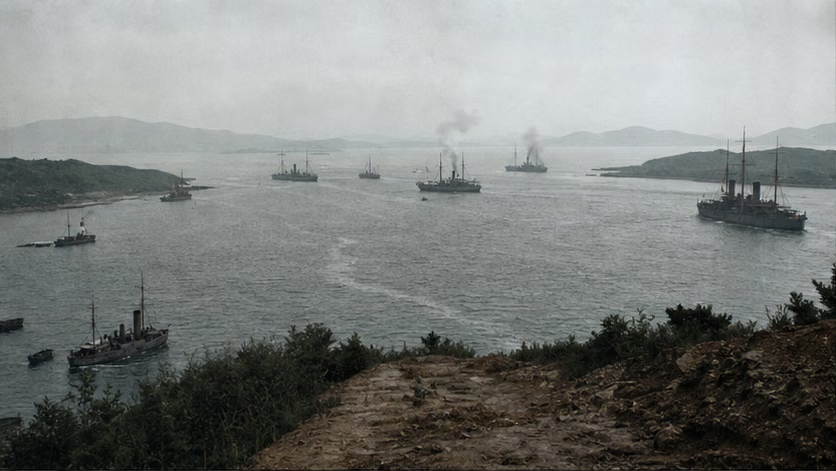 Outbreak of War: Pungdo and Seonghwan1894.07This war had three opening dates: July 23 for Koreans, July 25 at sea, and August 1 on paper; at sea, Japanese warships opened hostilities without a declaration, on land Seonghwan was a rearguard action, and after the fighting one memorial that turned defeat into great victory directly determined the commander of the next major battle.
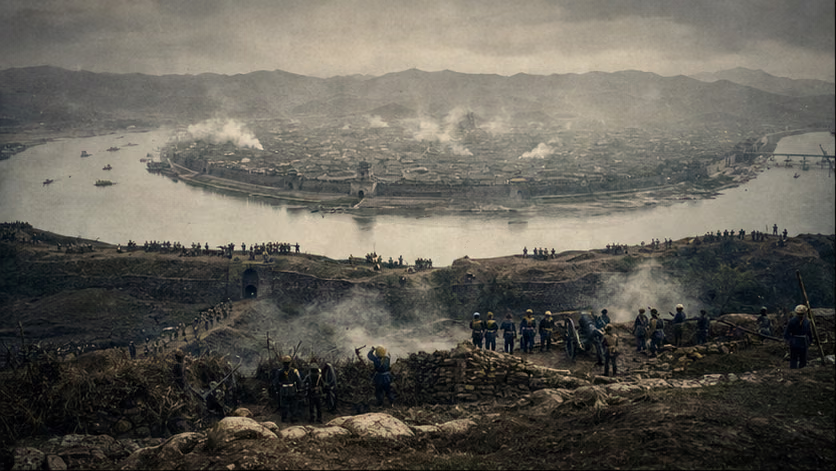 Battle of Pyongyang (1894)1894.09More than 13,000 Qing troops fought for one day at Pyongyang: the south of the city held, the northern heights were lost, the commander raised a white flag, and that night the whole army abandoned the city and fled north; after a six-day rush of more than 500 li, it withdrew west of the Yalu River, and all of Korea was thereby abandoned.
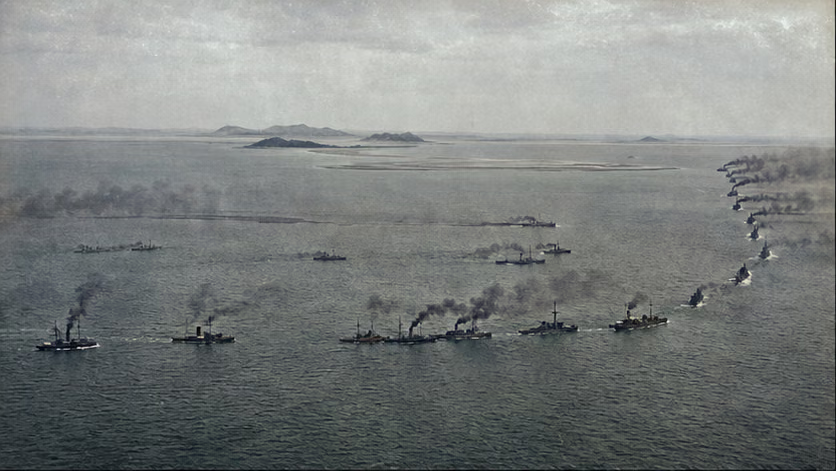 Battle of the Yalu River (1894)1894.09On the afternoon of 1894.9.17, twelve main warships of the Beiyang Fleet and twelve of the Japanese Combined Fleet fought for about five hours off Dadonggou at the mouth of the Yalu River: a rare large-scale fleet action of the steam-and-ironclad age. Beiyang lost five ships; Japan lost none. From that day, command of the Yellow Sea changed hands.
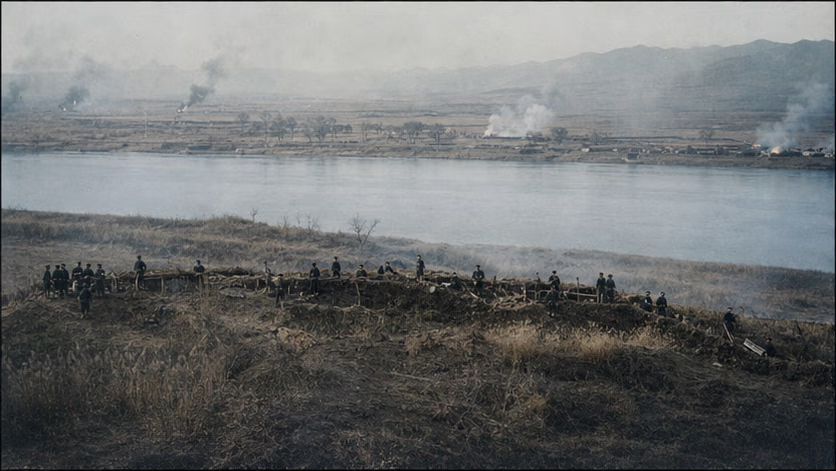 Defense of the Yalu River Line1894.10A line of more than 20,000 men spread along a frontier river fought in earnest for only one night on a single hilltop: once Hushan fell, the entire line collapsed without a fight, and from that point the flames of war entered China proper.
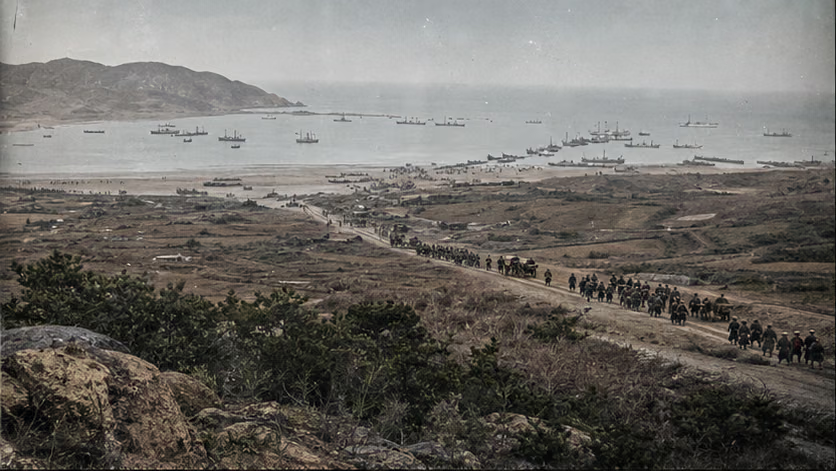 Battles of Jinzhou and Port Arthur1894.11For more than ten days after Japanese forces came ashore at Huayuankou, no one fired a shot at them; one month later, Port Arthur, built up over sixteen years and called the "foremost military port of the Far East," fell within a single day -- followed by four days of massacre.
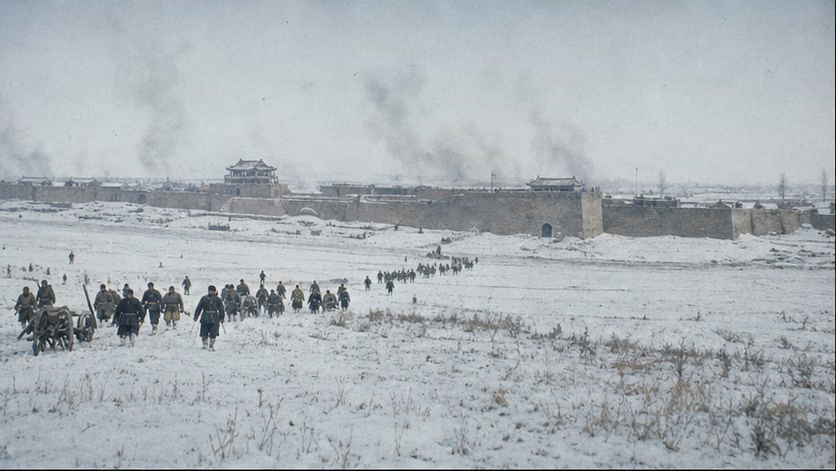 Seesaw Battles for Haicheng1894.12Japanese forces occupied Haicheng, the hub of southern Liaodong; Qing forces counterattacked by four routes, then five, through an entire winter, and never once fought their way in -- the longest stalemate of the First Sino-Japanese War on land, and the Qing army's final active offensive.
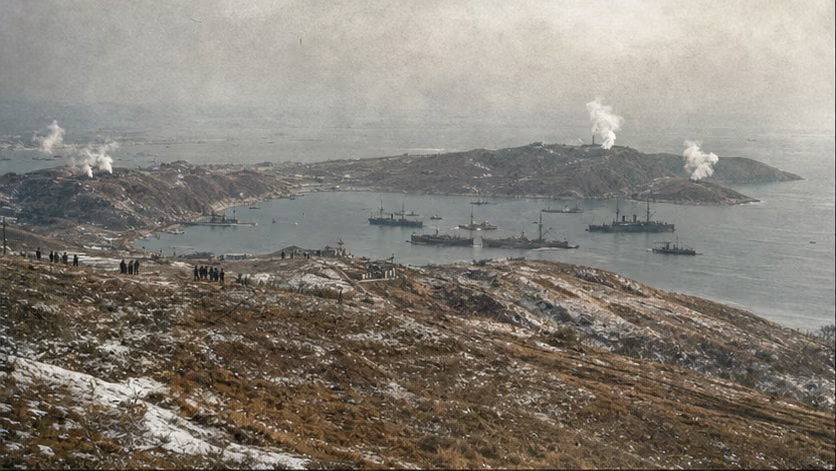 Battle of Weihaiwei1895.01The remnants of the Beiyang Fleet were ordered to sit fast inside Weihai harbor and "preserve the ships to control the enemy"; Japanese forces took the batteries on both shores from landward, turned the Qing forces' own coastal guns around, and bombarded the warships in the harbor--the admiral took his own life, the fleet surrendered in full, and the Beiyang Navy was destroyed.
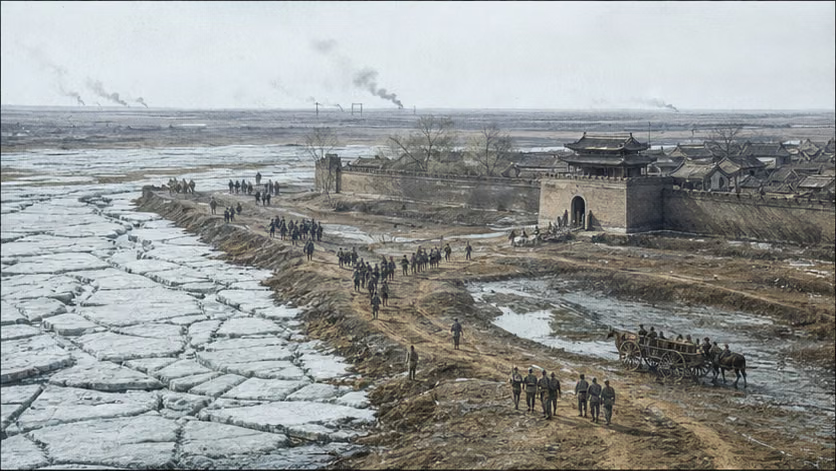 Collapse in Liaodong1895.03.04The seesaw battles for Haicheng dragged on into March 1895; Japanese forces turned south and took Niuzhuang, Yingkou, and Tianzhuangtai within six days--the Xiang Army's last battle beyond the Pass became the fiercest street fighting of the First Sino-Japanese War, followed by the final punctuation mark of the war on land: a town burned to the ground.
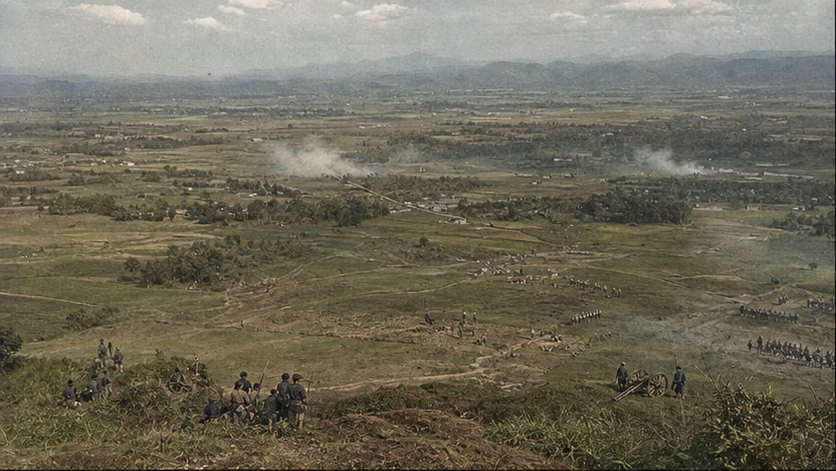 Resistance Against the Japanese Takeover of Taiwan (1895)1895.03.23A single treaty signed at Shimonoseki ceded Taiwan away; gentry and officials on the island set up a "republic" that lasted only a few months and refused Japanese rule; after officials crossed back to the mainland, volunteer armies and local people kept fighting from Audi to Tainan--more than 4,000 Japanese soldiers died of disease in the Taiwan campaign, dozens of times the number killed in battle; and the memory of Taiwanese resistance has lived on to the present day.
Sources and Open Questions
Main sources: Qi Qizhang, History of the First Sino-Japanese War and Research on the Port Arthur Massacre; Zong Zeya, The Qing-Japanese War (many Japanese-side figures are re-cited from this work); Mao Haijian's related textual studies on the Hundred Days' Reform (Gongche Shangshu entry); relevant volumes of the Japanese Defense Agency War History Office's Senshi Sosho (volume titles to be checked); Fujimura Michio, The Sino-Japanese War; Complete Works of Li Wenzhong, the Sheng Xuanhuai archives, and other Qing-side documents; Korean-side archives (the Annals of Gojong and others remain to be checked). Newspaper platforms: wartime Shenbao, and Japanese Jiji Shinpo and Kokumin Shimbun battlefield reports; originals need to be checked and logged.
Open questions: the statistical boundary for Japanese killed in action and dead of disease (whether it includes the 1895 Taiwan campaign); the different accounts of Qing combat deaths and total mobilization; the exact scope of "Beiyang added no ships or guns"; data on the Japanese quick-firing-gun rate-of-fire advantage; the multiple of Qing annual revenue represented by the indemnity; details of indemnity use (gold standard and the share of the Yawata Steel Works); details of Japanese forces seizing Gojong and installing a Daewongun puppet; whether the armistice excluded Taiwan and Penghu; the verdict in the Koyama Toyotaro case and details of Japan's handling of it; textual study of the historical facts of Gongche Shangshu; Korean scholarly phrasing of "Qing-Japanese War"; the original texts of the diplomatic notes by the three powers in the Triple Intervention; the decision details of Japan's "joint reform of Korea's internal administration" proposal (Mutsu Munemitsu's role); the Imperial General Headquarters texts of the three command-of-the-sea plans; the basis for Japanese predictions of British and great-power attitudes; the decision correspondence concerning reinforcements to Asan and the leasing of the Kowshing; details of Qing wartime fundraising.
All images on this site are AI-generated depictions. They are not historical photographs, not primary sources, and do not depict any real individual.